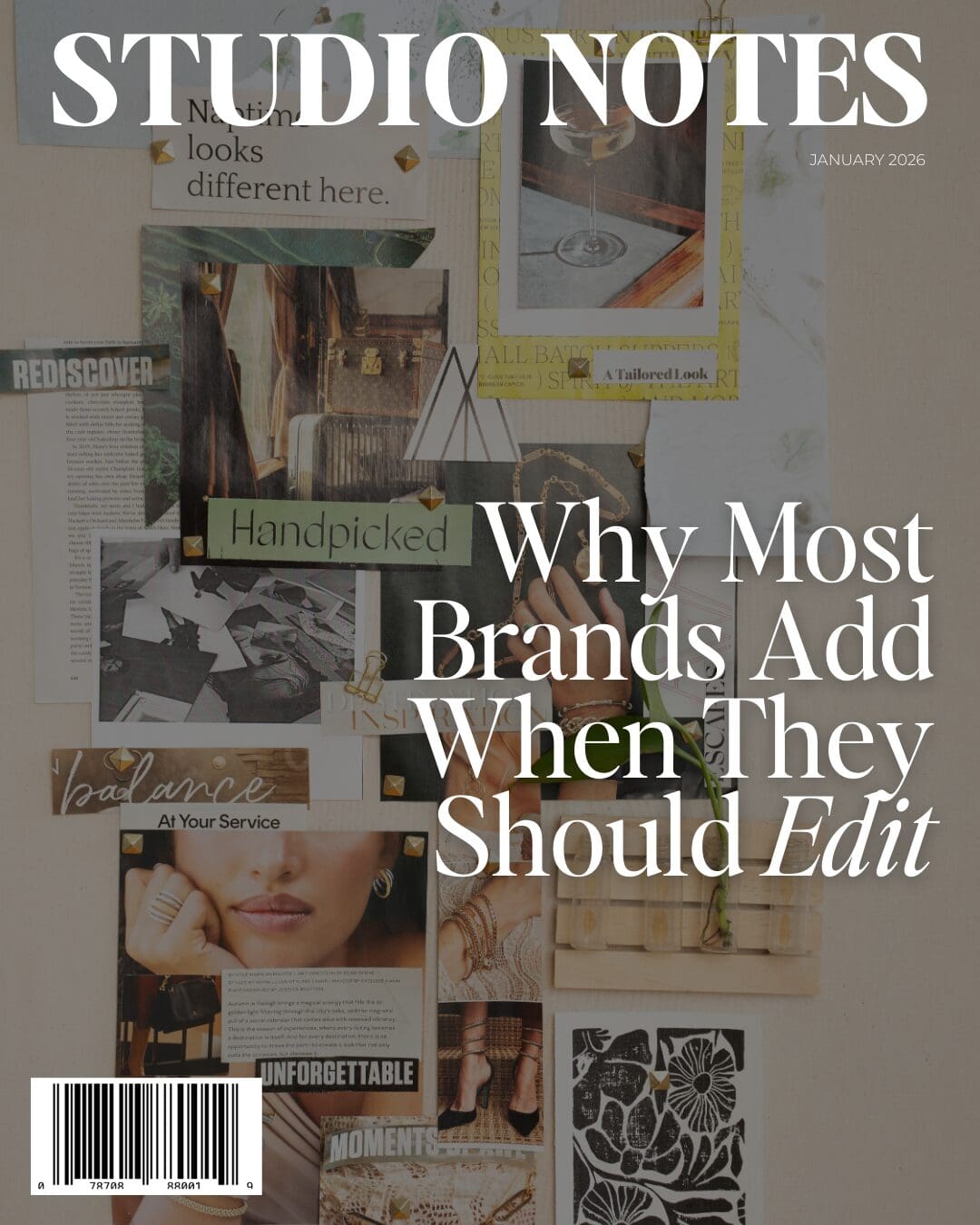
When something feels off, the instinct is often to add. Another section. Another color. Another explanation. Yet more rarely solves the problem. That’s why brand editing is often the solution.
Rather than asking what’s missing, the strongest editorial brands first ask: what doesn’t belong? What distracts? What dilutes clarity? This mindset—what I call editorial thinking—shifts the focus from accumulation to refinement.
Rather than asking what’s missing, the strongest editorial brands first ask: what doesn’t belong? What distracts? What dilutes clarity? This mindset—what I call editorial thinking—shifts the focus from accumulation to refinement.
Editing requires confidence. In other words, it demands trusting that the strongest ideas don’t need reinforcement. It means allowing space, hierarchy, and intention to carry meaning. Every margin, every pause, every element left unplaced communicates just as loudly as what remains.
Moreover, most brands overbuild because they fear being overlooked. They pile on features, visuals, and text, hoping to capture attention. However, presence doesn’t come from volume—it comes from focus. A layout that communicates with precision feels stronger, more assured, and more memorable.
Editorial Design Editing Creates Clarity and Focus
In editorial design, editing shapes clarity. Removing sections, reducing colors, or eliminating redundant elements is not a compromise. On the contrary, it elevates the work, creating rhythm and focus. Editing is intentional—it clarifies the narrative, directs the eye, and signals authority.
Design improves when excess is removed—not when it’s disguised with decoration or filler. Consequently, every decision to edit should serve purpose. It’s not about minimalism for minimalism’s sake; it’s about creating alignment between message, brand identity, and visual presentation.
Furthermore, editing ensures hierarchy works as it should. When unnecessary elements are removed, typography, imagery, and spacing gain impact. Each element earns its place, and the layout becomes easier to navigate. The viewer can focus without distraction. As a result, the design feels composed, professional, and intentional.
Ultimately, brands that add without editing may look busy or inconsistent. By contrast, brands that edit thoughtfully appear deliberate, confident, and elevated. They show that decisions are made with intention, not by default. Editing becomes a tool that transforms design from decoration into communication.
In the end, editorial design editing is not reduction—it is design with purpose. It creates space for meaning, clarity, and presence. It allows the strongest ideas to shine. It is alignment in action.
Editing isn’t just a step in the design process. It is the difference between noise and authority. It’s what separates a pretty layout from a professional one.
Follow along on Instagram
Explore my work on the website
Read more of my journal entries on the STUDIO NOTES